Why I-94 Still Matters
Why I-94 Still Matters
By Jason Shiggs
Please note this article is an opinion piece, and not necessarily the opinion of SUPC.
The Public Comment Period has been extended until March 23, you can weigh in here:
https://talk.dot.state.mn.us/rethinking-i94/news_feed/public...
If you ask me what connects the Twin Cities more than anything else, I’d say Interstate 94. For better or worse, it’s the backbone between Minneapolis and Saint Paul. It’s the route people take to work, to school, to hospitals, to events, and to family. It’s not pretty. It’s not charming. But it works.
I-94 is the fastest and most reliable way to move between the downtowns, and that matters more than we sometimes want to admit. In a region that depends on mobility for economic life, access to a high-capacity corridor isn’t a luxury — it’s infrastructure. Freight, emergency services, commuters, transit vehicles, and regional travelers all rely on that connection.
There’s also something to be said for certainty. The highway already exists. We know how it functions. We know how traffic behaves on it. And as a state highway, it is maintained and funded by MnDOT, which means long-term responsibility doesn’t fall on already-stretched city budgets. Upgrading I-94 is not an experiment — it’s an investment in something that already works.
I understand the desire for transformation. I really do. But not every corridor needs to be reinvented to serve the public well. Sometimes the most responsible choice is to fix what exists, improve safety, modernize design, and keep the system functioning.
Not everything meaningful is visionary. Some things are simply necessary. I-94 is one of them.
Why a Boulevard Future Is Worth Imagining
If you ask me what kind of city I want to live in, I’ll tell you this: one where streets connect neighborhoods instead of dividing them. One where walking feels natural. Where crossing the street doesn’t feel like taking your life in your hands. Where transportation infrastructure serves people, not just traffic.
That’s why the idea of replacing I-94 with a boulevard matters.
Highways move cars efficiently — but they also bring noise, pollution, and physical separation. They create barriers where there could be connections. A boulevard flips that logic. Slower speeds mean less noise. Fewer emissions. Streets that feel human again. Crossings at street level instead of overpasses. Spaces that invite people to walk instead of rush through.
But more than design, this is about how a place feels. A boulevard creates the possibility for local life — local buses that actually stop, local businesses that people can reach on foot, and neighborhoods that face each other instead of turning their backs to a concrete trench.
I don’t pretend that every promised benefit is guaranteed. Development isn’t automatic. Investment doesn’t happen just because you change pavement. But opportunity matters. And right now, the highway consumes space without giving much back to the neighborhoods around it.
A boulevard isn’t just a transportation project — it’s a statement about priorities. It says that cities are for living, not just moving through. That access matters as much as speed. That health, connection, and dignity belong in infrastructure decisions.
We can build roads for cars — or we can build streets for communities. I know which future I want to walk in.
The Pros and Cons of the Options
Option 1: Upgrading I-94
Overview:
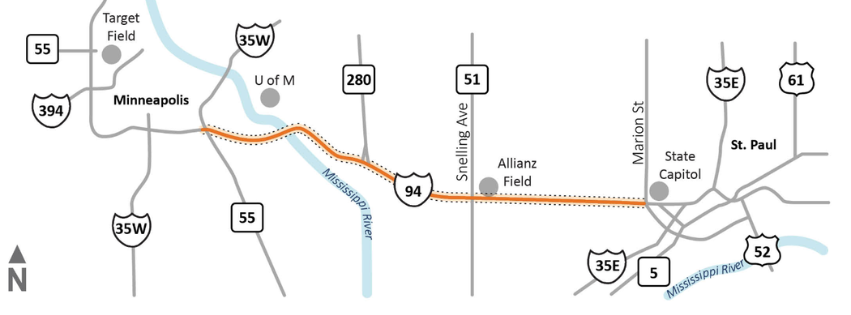
The Minnesota Department of Transportation (MnDOT) is leading the “Rethinking I-94” process, which includes reviewing long-term alternatives for the 7.5-mile section of interstate between the Twin Cities. This stretch of freeway is nearing the end of its design life, prompting a once-in-a-generation decision about how it should be rebuilt.
Pros
Fastest Route Between Downtowns – Maintaining a freeway ensures high-speed travel for commuters and freight, minimizing travel times between Minneapolis and Saint Paul.
Existing Infrastructure – The highway is already in place and familiar to users. Upgrading rather than replacing means more predictability in construction impacts and outcomes.
State Funding and Maintenance – As a state highway, I-94 is funded and maintained through state transportation budgets. It’s uncertain whether a new boulevard would receive the same level of ongoing funding.
Cons
Environmental and Health Impacts – High vehicle speeds and volumes contribute to higher emissions of particulate matter and CO₂, with associated adverse effects on air quality and public health.
Limited Public Transit Benefits – While current and planned transit investments like the Metro Transit Gold Line help (extending rapid bus service between downtowns), the highway’s design limits frequent local stops and connectivity along the corridor.
Option 2: Twin Cities Boulevard Conversion
Overview:
Advocates led by Our Streets Minneapolis have proposed replacing this section of I-94 with a multimodal boulevard, filling in the freeway trench and restoring at-grade connections between neighborhoods. This concept is rooted in transportation planning movements across the U.S. that seek to undo the negative effects of mid-20th-century highways on urban communities.
Pros
Reduced Noise and Pollution – Slower traffic and an emphasis on active and public transportation could reduce air and noise pollution in adjacent neighborhoods, improving quality of life.
Pedestrian-Friendly Design – A boulevard with at-grade crossings could create a more pleasant and safer environment for walking and biking compared with navigating pedestrian bridges over a freeway trench.
Enhanced Local Transit Access – A multimodal boulevard could support frequent local bus service with many stops along the corridor, increasing accessibility.
Development Potential – Reclaiming right-of-way from the highway opens land for housing, parks, and commercial uses, potentially stimulating economic activity and reconnecting divided neighborhoods.
Cons
Uncertain Realization of Benefits – Some projected advantages, such as increased housing or retail investment adjacent to the boulevard, depend on future market and policy conditions and are speculative.
Local Maintenance Costs – Transitioning to a boulevard could shift responsibility for upkeep to local governments unless state or federal funding is secured.
Traffic Concerns – Large event traffic (e.g., from U.S. Bank Stadium or Allianz Field) could become more disruptive on an at-grade street, with congestion potentially spilling onto local roadways.
Converting a highway to a to a slower, at-grade road without replacing capacity elsewhere could result in inefficiencies or increased delay for through traffic.